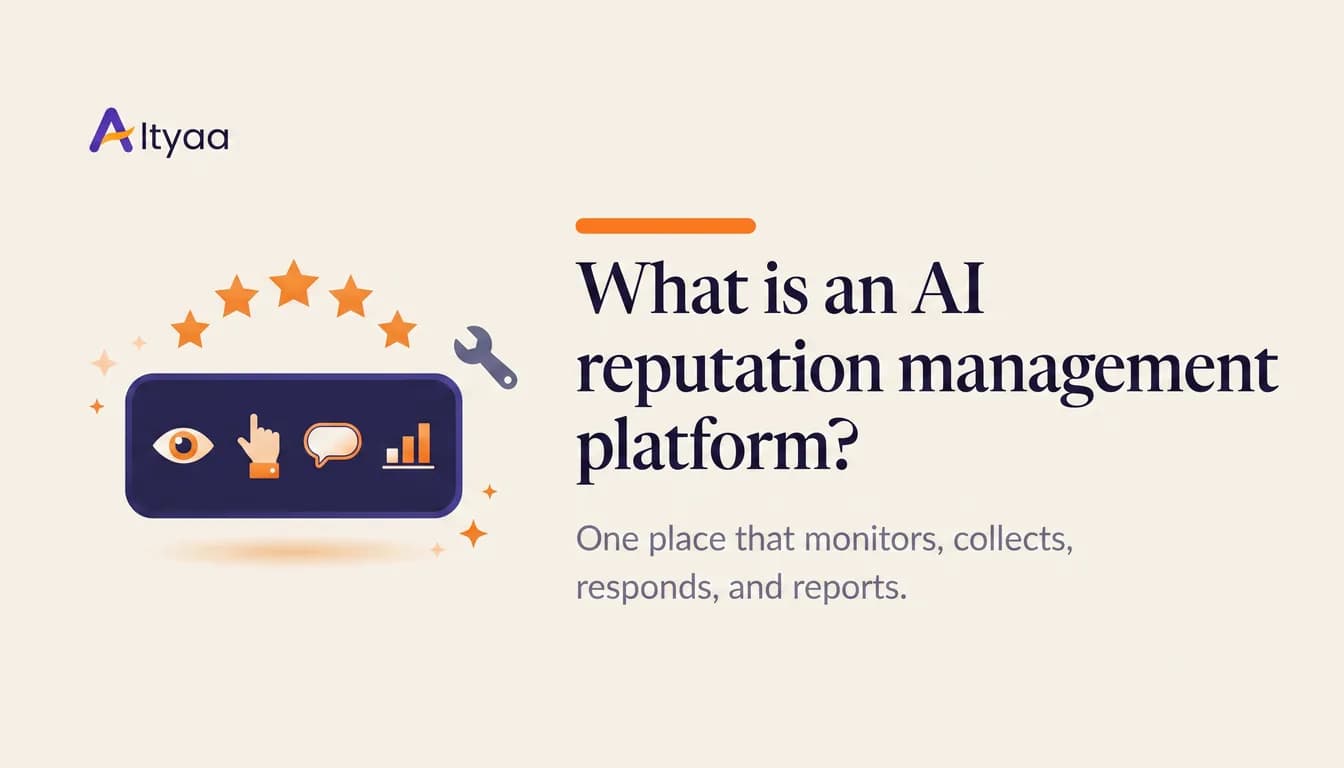
An AI reputation management platform is one place that runs the whole review loop: it pulls your reviews in as they land, helps you ask for new ones, drafts replies you approve, and reports back on what is changing over time — across more than one source rather than just Google. The AI sits inside those steps; it does not replace them. A single-purpose tool does one leg of that loop. The word doing the work in that phrase is "platform", not "AI".
What makes it a platform and not a tool
Four legs, and it needs all four to earn the name. Monitor: reviews arrive somewhere you will actually see them. Collect: you ask customers for new ones on purpose. Respond: you answer, in your voice. Report: you can see what changed this month against last. Then the condition that sits over all four — across more than one source.
That last part matters, because Google alone already does two of the four for free. Google Business Profile sends "Customer activity" notifications when customers leave new reviews or add photos, by email, in Search or in Maps. And once your business is verified, you can reply to reviews and edit or delete your own replies, with the customer notified when you do.
So monitoring and responding on Google are not a product. They are a free feature you may not have switched on. A platform has to earn its keep on the parts Google does not cover: the sources that are not Google, the asking, and the reporting that survives longer than one month.
What the AI actually does today
Two things, honestly. It drafts a reply for you to approve, and it groups many reviews into themes and sentiment. Those two are where the substance sits, whatever a feature list calls them.
Drafting is the most useful and least mysterious. Vendor pages describe it the way you would hope: Birdeye's review response agent "Reads the full review — text, photos, and past visits," "Responds in your brand voice," and "Posts on its own, or holds for approval — you decide." Holds for approval. The draft is the product; the send is yours. A reply is also the only thing anyone gets to write here — Google lets an outside tool reply to a specific review and nothing beyond that, with no way for a business to create or edit the customer's review itself.
Grouping is worth understanding, because Google is already doing it in public. The short review snippets under your listing are selected by an algorithm from the keywords most mentioned in reviewers' quotes, and Place Topics show a prevalent sentiment based on the sentiment of the underlying reviews — and if your business does not have Place Topics, Google cannot create them on demand. The machine reading of your reviews is not a future feature you are buying: it is already happening on the customer-facing side, and strangers see the output first. What a platform adds is that same reading turned around to face you, across more than one site.